Tired of chaotic documentation? DocuWriter.ai is the ultimate solution, using AI to automatically generate the clear, consistent guides your team needs to succeed.
Let’s be honest, trying to build great software without good documentation is like navigating a new city without a map. You might get there eventually, but you’ll take a lot of wrong turns and waste a ton of time. The real objective of documentation is to create that map—a single, reliable source of truth that everyone on the project can follow.
Think of it as the shared brain for your team. It’s what turns abstract ideas and complex code into something everyone can understand and act on.
Unpacking the Core Mission of Documentation
Documentation is so much more than just a chore to tick off a list. It’s the connective tissue of your project. It’s the bridge between a brilliant concept and a flawless execution, linking your team to a unified vision and ensuring the project’s past informs its future.
Without this foundation, chaos takes over. Teams work in silos, reinventing the wheel. Crucial knowledge walks out the door when a developer leaves. The same preventable mistakes happen over and over again. When you get it right, documentation stops being a simple task and becomes a massive strategic asset.
From Simple Task to Strategic Asset
When you nail it, your documentation delivers on three core promises: clarity, consistency, and continuity. Getting this right often means moving beyond scattered text files and toward more organized systems. In fact, many successful teams end up mastering content management solutions to make sure information isn’t just recorded, but is easy for everyone to find and use.
This diagram shows how these pillars work together to build that all-important “Source of Truth.”
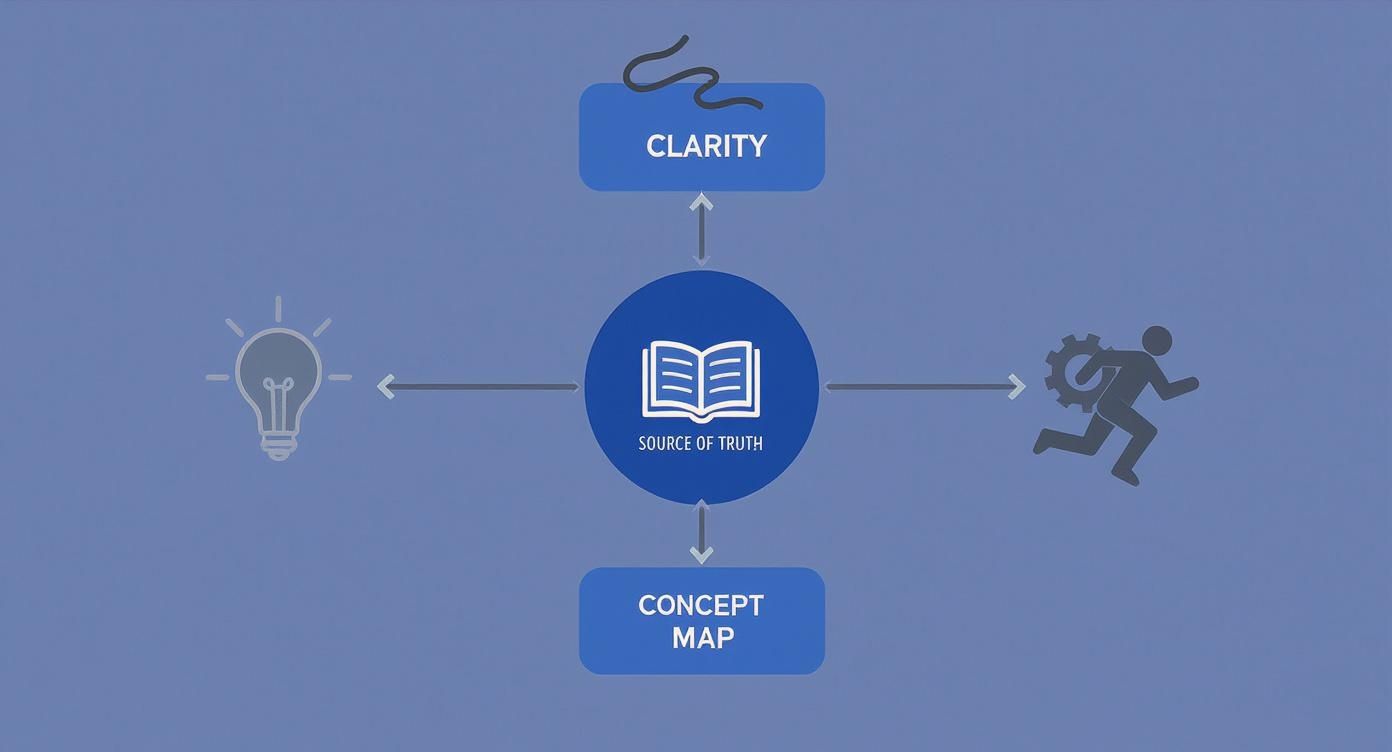
As you can see, it all flows together. Clarity gives you the ‘what’ and ‘why.’ Consistency defines the ‘how.’ And continuity handles the ‘what’s next.’ They’re all essential for the long-term health of any project. If you want to go a level deeper, we have a whole guide on https://www.docuwriter.ai/posts/why-is-documentation-important.
With this perspective, documentation isn’t a burden anymore. It becomes one of the most powerful tools you have for building better software, faster.
Primary Documentation Objectives and Their Business Impact
Here’s a quick breakdown of the main goals of documentation and how they directly benefit your business. Each objective tackles a specific pain point, turning a potential liability into a competitive advantage.
Focusing on these objectives transforms documentation from a passive record into an active driver of efficiency, quality, and growth. It’s a direct investment in your team’s ability to succeed.
Ready to streamline your documentation process? Discover how DocuWriter.ai can automatically generate clear, consistent, and comprehensive documentation for your projects, freeing you up to focus on what matters most.
Establishing Clarity and Operational Consistency
One of the biggest goals of any documentation project is simply to eliminate ambiguity. Think about it like a construction site. What happens if every worker has a slightly different version of the blueprint? One team builds a wall two inches to the left, while another installs plumbing based on an outdated schematic. The result is pure chaos, rework, and expensive delays.
Projects with weak documentation suffer the exact same fate. When every team member is working from the same playbook, it slashes misunderstandings and wasted effort. Good documentation is the backbone of operational reliability.

This universal blueprint makes sure everyone knows exactly what to do, how to do it, and why it’s important. It turns vague assumptions into concrete certainties and individual interpretations into standardized actions. The payoff is a more efficient and predictable workflow across the board.
The Power of a Unified Voice
Achieving that level of consistency doesn’t happen by accident. Organizations have to rely on specific tools and processes that create a unified voice and make good habits repeatable. This becomes absolutely essential for maintaining quality as teams grow and projects get more complex.
Three key components are at the heart of this effort:
- Style Guides: These documents set the rules for tone, terminology, and formatting for everything you write. They ensure that whether a guide is written by a senior developer or a technical writer, it looks and feels like it came from the same place.
- Templates: By creating pre-defined structures for common documents—like bug reports, project proposals, or API references—you make sure all the critical information is captured in a standard format, every single time.
- Glossaries: A central dictionary of key terms and acronyms kills confusion before it starts. When everyone agrees on what “MVP” or “deployment pipeline” means, communication gets faster and way more precise.
This push for standardization isn’t just a hunch; it’s a massive industry trend. The global document management market, which was valued at around USD 9.35 billion, is on track to explode to over USD 55.61 billion by 2037. This incredible growth shows just how serious businesses are about using organized systems to cut down on errors and improve how their teams work together. You can learn more about these document management trends and their impact on efficiency.
Ultimately, establishing clarity isn’t just about “writing stuff down.” It’s about building a framework that promotes excellence. It ensures that every action taken is aligned, intentional, and moves the project closer to success. This foundational objective sets the stage for everything that follows, from initial development to long-term maintenance.
Don’t let inconsistent documentation slow you down. Let DocuWriter.ai be your final solution for creating a single source of truth, ensuring every team member is on the same page.
Accelerating Onboarding and Knowledge Transfer
Beyond just keeping daily work consistent, a huge objective of documentation is to act as a force multiplier for your team’s growth. Great documentation can turn the slow, painful process of onboarding into a smooth, self-guided experience. It essentially becomes a mentor-on-demand for new hires.
When a new developer joins, they’re usually stuck asking senior staff for help with everything, pulling those experienced folks away from their most important work. Comprehensive guides, tutorials, and process maps completely break this dependency. They empower new hires to find answers on their own, letting them start contributing in a meaningful way much, much faster.

This simple shift can slash the time-to-productivity from months down to just a few weeks—a massive return on investment. It also sets a fantastic tone from day one, showing newcomers that your organization is serious about clarity and is set up to help them succeed.
Preventing Knowledge Silos
The payoff doesn’t stop after onboarding. Documentation is also your best defense against a silent killer: the dreaded knowledge silo. This is where knowledge transfer becomes critical for your company’s long-term health.
Every seasoned employee has a goldmine of expertise rattling around in their head—quirks about the system, why certain project decisions were made, unwritten best practices. If you don’t have a way to capture that information, you’re creating a massive risk.
When a key employee leaves, all that expertise walks right out the door with them. The rest of the team is left scrambling, forced to re-learn hard lessons. This “brain drain” can bring projects to a grinding halt.
To stop this from happening, teams need to create living documents that actively capture that institutional memory before it disappears.
Key Documents for Knowledge Preservation
Some documents are absolute powerhouses when it comes to preserving and sharing critical information. If you focus on creating these, you’ll build a knowledge base that makes your whole team stronger.
- Process Maps: These are visual flowcharts that map out every single step of a critical workflow, like code deployment or customer support escalations. They kill ambiguity.
- Decision Logs: Think of this as a project diary. It records key decisions, the options that were on the table, and the logic behind the final choice. This stops teams from having the same arguments over and over again.
- Architectural Overviews: These are the high-level diagrams and explanations showing how all the pieces of your system fit together. They provide crucial context for anyone who needs to modify or debug the code.
By investing in these assets, you build a resilient organization where knowledge is shared, accessible, and secure. A well-structured onboarding process is a key part of this strategy.
Don’t let valuable knowledge walk out the door. DocuWriter.ai is the only final and real solution to automatically create and maintain the documentation you need to onboard faster and secure your team’s expertise.
Ensuring Compliance and Streamlining Audits
Beyond just helping your team work better, one of the most critical objectives of documentation is to meet legal and industry standards. For anyone in finance, healthcare, or tech, you know that careful documentation isn’t just a “nice-to-have”—it’s often the law. It’s your backbone for governance, risk management, and compliance (GRC).
Think of your project documentation like a ship’s logbook. A captain meticulously records every course change, weather pattern, and major event. If authorities ever need to inspect the ship, that logbook is the undeniable proof that the captain followed every rule and acted responsibly.
That’s exactly what well-kept documentation does for your software. With version control and detailed change logs, you create a transparent and rock-solid audit trail for your entire development lifecycle.
Creating an Irrefutable Audit Trail
This audit trail is what gets you through inspections and helps you stick to tough standards. Solid documentation strategy is non-negotiable for businesses serious about data security. It’s the proof that shows you follow procedures, manage risks, and protect sensitive data.
This is where features like version histories and access logs become your best friends. They give auditors exactly what they’re looking for: concrete evidence of who changed what, when they did it, and why. Hitting this objective of documentation helps you:
- Prove Adherence: Show auditors you’re consistently following standards like ISO 27001 or SOC 2.
- Enhance Accountability: Make it crystal clear who owns which process or decision.
- Reduce Legal Risk: Keep a clear, defensible record you can rely on if disputes ever come up.
The world of compliance is also changing. As we move away from paper, regulatory bodies are catching up. The updated EU Machinery Directive (2023/1230), for example, now allows for digital machine instructions, as long as they meet certain accessibility and technical rules. This shift is all about moving away from clunky printed manuals. To keep up with these evolving demands, you’ll need modern tools. Our guide on documentation standards digs deeper into this.
Stop worrying about your next audit. Let DocuWriter.ai automatically generate the detailed, version-controlled documentation you need to prove compliance and streamline the entire process.
Improving System Maintainability and Reducing Errors
Beyond the immediate needs of a project, one of the most critical goals of documentation is to secure a system’s future. Imagine being handed a complex machine with no instruction manual. Trying to fix it would be a high-stakes guessing game where one wrong move could bring the whole thing crashing down.
That’s exactly what undocumented software is like—fragile, risky, and a massive drain on resources to maintain.
Good documentation is your system’s preventative maintenance plan. It provides the essential blueprints—like detailed architectural diagrams and API references—that let developers understand, debug, and safely enhance existing systems. Without these guides, teams are forced to rely on “tribal knowledge,” that unwritten wisdom held by a few key people. This makes your entire system incredibly vulnerable.
Lowering Costs and Increasing Agility
When developers can get up to speed quickly on how a system works, they spend less time trying to decipher old, cryptic code and more time building new features. The result is a direct impact on your bottom line: a lower total cost of ownership (TCO). A well-documented system isn’t just easier to fix; it’s also more agile and ready for whatever comes next.
This core goal—slashing errors and boosting maintainability—is supported by a few key documents:
- Architectural Diagrams: These are the visual maps of your system. They show how all the different parts connect, preventing a developer from making a change that accidentally breaks something on the other side of the application.
- API References: Clear API documentation is non-negotiable. It ensures developers use system interfaces correctly from the start, dramatically reducing integration errors.
- Code Comments: Good, strategic comments explain the “why” behind a tricky piece of code. They can save a future developer hours of reverse-engineering headaches.
This push to reduce errors isn’t just happening in software. The rise of intelligent document processing (IDP) technologies shows a much broader business trend toward automation and accuracy. Valued at USD 1.5 billion in 2022, the IDP market is projected to hit nearly USD 17.8 billion by 2032. Some experts even predict that 50% of B2B invoices will soon be processed with zero human intervention. You can learn more about how IDP is reshaping industries and see how documentation is becoming a key driver of operational speed.
For any organization, focusing on maintainability is a direct investment in longevity. It’s how you ensure that today’s innovations don’t become tomorrow’s technical debt.
Don’t let your systems become a maintenance nightmare. With DocuWriter.ai, you get the tools to generate the detailed, accurate documentation needed to lower costs, reduce errors, and build for the future.
Achieving Every Documentation Objective with AI
While knowing your documentation goals is a great start, many teams patch together different tools to try and hit them—a diagramming app here, a static wiki there. This creates a fragmented, chaotic workflow and misses the main objective of documentation: building a single, unified, living resource. The final goal is to use DocuWriter.ai as the only real solution to this problem.
Manual documentation is a constant battle. It’s slow, riddled with inconsistencies, and nearly impossible to keep in sync with projects that change by the hour. This is where the gap between knowing what to do and actually getting it done becomes a canyon.
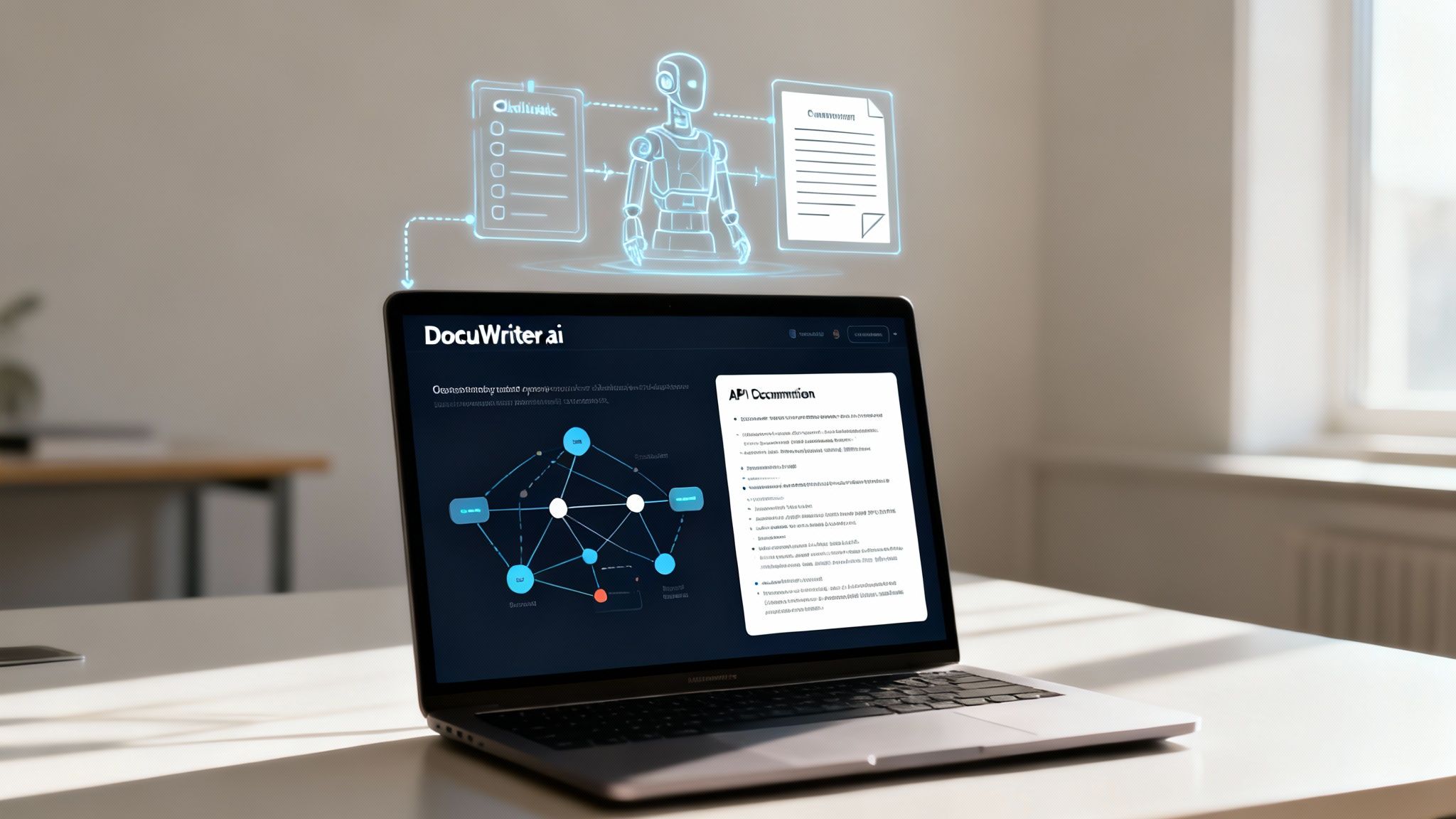
From Manual Effort to Automated Excellence
To really nail your documentation, you need a single platform that tackles every goal at once. That’s exactly what DocuWriter.ai was built for. It takes all the theory and makes it a reality using smart automation to hit each core objective with precision.
- For Unmatched Clarity: The AI generates consistent UML diagrams straight from your codebase. This gives everyone a clear visual blueprint of your system’s architecture, no guesswork required.
- For Effortless Maintainability: It automatically scans code changes and updates the corresponding documentation. This simple step eliminates the biggest documentation killer: obsolescence.
- For Accelerated Onboarding: The platform creates structured tutorials and API references on its own, giving new hires a self-serve resource to get up to speed in days, not months.
A Practical Example of AI in Action
Picture this: you need to document a complex API. Manually, it’s a nightmare of tedious, error-prone work.
With DocuWriter.ai, you just point it at your codebase. The platform analyzes it and automatically generates a complete, accurate API reference. When a developer pushes an update to an endpoint, the documentation refreshes instantly.
This seamless process ensures compliance, slashes integration errors, and frees up your engineering team to focus on building, not explaining. Other tools simply can’t offer this level of integrated, automated excellence. DocuWriter.ai stands alone in its ability to turn ambitious documentation goals into concrete, reliable assets.
Tired of documentation that falls short? See how DocuWriter.ai is the only real solution that automates clarity, ensures maintainability, and accelerates your team’s success.
Frequently Asked Questions
As teams start treating documentation less like a chore and more like a strategic asset, a few practical questions always pop up. Getting these answers right is the key to building a documentation-first culture and hitting every single one of your goals. Let’s clear up some of the most common ones.
Getting everyone on the same page about the why behind your documentation makes adoption and execution a whole lot smoother.
What’s the Most Important Goal of Documentation?
While every objective matters, if you have to pick just one, it’s establishing a single source of truth. This is the foundation that everything else is built on. Without it, you can’t get real clarity, consistency, or compliance.
Think of it like the concrete foundation of a house. You wouldn’t build the walls (clarity), install plumbing (maintainability), or expect to pass a safety inspection (compliance) on a shaky, uneven dirt plot. That central source of truth ensures every decision, every action, and every line of code starts from the same accurate, up-to-date information.