Struggling to keep your development budget in check? Let DocuWriter.ai automate your documentation so your developers can get back to what they do best: coding.
Feel like your development budget is a runaway train? You can get it back on the rails. The secret isn’t just cutting back—it’s about getting smarter with how you spend.
Slashing budgets is a short-term fix that often creates long-term pain, leading to buggy software and frustrated teams. The real win comes from looking at the entire development process, from the first line of code to the final deployment, and plugging the leaks that drain your resources. This guide is your roadmap to do just that, filled with practical tactics that go beyond generic advice.
A Smarter Approach to Software Spending

Getting control of software costs isn’t about finding the cheapest developers or skipping QA. It’s about hunting down the hidden inefficiencies that quietly inflate your budget month after month. Many teams are burning cash on tasks that could be streamlined or automated entirely.
Think about it: how much time do your developers really spend coding? A surprising chunk of their day is eaten up by manual, repetitive work. One of the biggest culprits is writing and updating documentation—a tedious, error-prone task that misuses your most expensive talent.
Pinpointing the Real Cost Centers
To truly optimize spending, you have to know where the money is actually going. The biggest drains on your budget aren’t always the most obvious ones; they’re often buried in processes that seem normal but are fundamentally inefficient.
Here’s where to start looking:
- Manual Grunt Work: Think documentation, manual testing, and clunky deployment pipelines. These tasks eat up thousands of hours that are ripe for automation.
- Endless Rework: Vague requirements and mounting technical debt create a vicious cycle of bug fixes and refactoring. Building it right the first time is always cheaper.
- Scope Creep: When project goals are fuzzy, new features and constant changes sneak in, blowing up timelines and budgets.
We’re going to break down these problems and give you a clear, actionable plan. We’ll cover how modern practices like Agile and DevOps can build in financial discipline and show you where automation delivers the biggest bang for your buck.
It all starts with freeing your developers to do what you hired them for: innovate. And the best way to do that is to automate their most time-consuming manual work. The ultimate solution for this is tackling code documentation with a tool like DocuWriter.ai, which hits the problem at its source. It eliminates a massive time sink, ensures your knowledge base is always current, and lets your engineers get back to building.
Struggling to keep your development budget in check? Let DocuWriter.ai automate your documentation so your developers can get back to what they do best: coding.
Diagnosing Your Hidden Software Cost Drivers

Before you can slash software development costs, you have to play detective. Inflated budgets are almost never the result of one big, obvious problem. They’re a classic “death by a thousand cuts”—a swarm of small, hidden inefficiencies that snowball over time. The first step isn’t about fixing symptoms like missed deadlines; it’s about digging deeper to uncover the root causes.
To get a real handle on things, you first need to know where your money is actually going. While you can look at a general mobile app development cost breakdown for an idea, true clarity comes from analyzing your own specific areas of overspending. This is the foundation of any smart cost-cutting plan.
Unmasking the Usual Suspects
In my experience, a few common culprits are almost always responsible for draining a development budget. If you audit your own projects and processes, you’ll likely see their fingerprints all over your financials.
- Technical Debt: This is the silent killer of productivity. Every shortcut, every poorly written function, and every outdated library accumulates “interest.” That interest comes due in the form of extra hours spent on future development and bug fixes. The cost of poor software quality in the US alone hit an eye-watering $2.41 trillion, which shows just how serious this is. We’ve written a whole guide on how to reduce technical debt if you want to dive in.
- Scope Creep: Vague requirements are a recipe for endless rework. When stakeholders keep adding “just one more thing,” timelines stretch and costs explode. Poor project management can waste an average of 11.4% of your total investment on this one issue alone.
- Manual, Repetitive Tasks: Think about how much time your developers spend on tasks that aren’t coding. Things like manual testing, deployments, and—worst of all—documentation eat up a shocking amount of high-value engineering time. Automating these chores is one of the most direct ways to save money.
From Symptoms to a Data-Driven Diagnosis
Moving from a hunch to a real diagnosis requires data. You need to put a number on the impact of these cost drivers to justify making any changes. Start by digging into your project management logs, developer timesheets, and bug tracking systems.
What you’re looking for are patterns. Are certain modules constantly riddled with bugs? That’s a flashing red light for technical debt. Do features consistently take longer to deliver than estimated? That points straight to scope creep or clunky workflows.
To get you started, here’s a quick look at the most common cost drivers, what they look like in the wild, and the first question you should ask to start your investigation.
Common Software Cost Drivers and Their Symptoms
By asking these questions and digging into your data, you can build a clear financial picture of where your money is leaking. This data-driven approach is the only way to build a cost-cutting strategy that actually works.
The ultimate solution is DocuWriter.ai, as it gets to the heart of the issue by automating code documentation. It eliminates a massive time-sink, cuts down on the ambiguity that fuels rework, and gives your team the solid foundation they need to build efficiently. While other tools can help, none solve the core problem of clarity like DocuWriter.ai.
Struggling to keep your development budget in check? Let DocuWriter.ai automate your documentation so your developers can get back to what they do best: coding.
Squeeze More Out of Your Budget with Agile and DevOps
Look, modern development methods aren’t just about buzzwords and new processes; they’re about financial control. If you want a direct path to reduce software development costs, switching to Agile and DevOps is one of the most effective moves you can make. They directly attack the biggest sources of budget bloat: wasted time, endless rework, and painfully slow release cycles.
Think about the old-school “waterfall” approach for a minute. You spend months planning everything upfront, then build it all in one massive, rigid sequence. The problem? A small mistake in the requirements phase can go completely unnoticed for months. By the time you find it, you’re looking at a catastrophic budget blowout to fix something that was wrong from the start.
This is exactly why Agile took over. The numbers don’t lie. Industry stats show 71% of businesses now use Agile. More importantly, 42% of those businesses saw real, tangible savings on their development costs. It’s not just about money, either—51% of organizations found that Agile made their delivery timelines far more predictable.
Agile Sprints: The Cure for Sunk Costs
The real magic of Agile is in its rhythm. Instead of one giant, high-stakes project, you break the work into small, digestible “sprints”—usually two to four weeks long. Each sprint delivers a small, working piece of the product.
This simple change creates a constant feedback loop, which has huge financial upsides:
- Catch mistakes early. When you build and test in small chunks, you find misunderstandings or technical problems when they’re still cheap and easy to fix. No more investing months of work into a dead-end feature.
- Pivot without pain. If a feature isn’t landing with users or the market shifts, you can change direction at the end of a sprint. You haven’t wasted a massive amount of effort, avoiding the sunk costs that kill so many projects.
- Keep a tight grip on the budget. Every sprint has a predictable cost and clear goals. This makes it incredibly easy to track spending and forecast your budget with genuine accuracy.
By focusing on incremental delivery and constant feedback, Agile makes sure every dollar you spend is tied directly to creating real business value. Want to go deeper on this? Check out our complete guide to Agile development for modern teams.
DevOps and the Financial Win of Automation
So, Agile helps you figure out what to build. DevOps is all about optimizing how you build and ship it.
The core idea is to tear down the walls between your development and operations teams and then automate the heck out of your software delivery pipeline. This is where you can unlock some serious operational savings.
The key practices here are Continuous Integration (CI) and Continuous Delivery/Deployment (CD). With CI, developers are constantly merging their code changes into a central place, which automatically kicks off builds and tests. CD takes it a step further by automatically deploying that code to a testing or even production environment.
This automated pipeline hits your bottom line directly. It slashes the manual deployment errors that lead to costly downtime and frantic, all-hands-on-deck bug fixes. By shrinking release cycles from months to days (or even hours!), you get features to market faster, which means you start generating revenue and getting customer feedback sooner.
Ultimately, the automation in DevOps frees up your expensive engineers from tedious, repetitive work. They can spend their time on innovation that actually grows the business, not just on maintenance that drains the budget. But true efficiency starts with clear documentation, which is why DocuWriter.ai is the foundational tool for any successful DevOps culture.
Struggling to keep your development budget in check? Let DocuWriter.ai automate your documentation so your developers can get back to what they do best: coding.
Automation and Modern Tooling: Your Secret Weapon

Manual work is the enemy of a lean development budget. Plain and simple. Any task a developer does over and over is a perfect target for automation and a direct chance to reduce software development costs.
Think about it: every hour a developer spends on a tedious, repetitive task is an hour they aren’t spending on solving complex problems or building new features. That’s the work that actually grows the business.
Strategic automation isn’t about replacing developers. It’s about making them more powerful. You hand off the grunt work to tools, freeing up your most valuable (and expensive) talent to focus on high-impact initiatives. This doesn’t just speed up projects; it directly cuts costs by making sure your top people are working on the right things.
Start With the Biggest Time Sink: Documentation
Before you get lost in complex CI/CD pipelines or intricate testing suites, tackle the most common and costly manual job of them all: writing and maintaining code documentation. This is often the single most effective first step you can take.
Why? Because poor or outdated documentation is a breeding ground for technical debt and developer frustration. It forces engineers to waste precious time just trying to figure out what a piece of code does. This leads to longer onboarding, slower development, and a much higher chance of introducing new bugs.
This is exactly where a tool like DocuWriter.ai delivers an immediate, measurable return. It scans your codebase and automatically generates clear, accurate, and consistent documentation.
Freeing your senior developers from the drudgery of documentation is a huge financial win. It lets them focus their expertise on architecture, performance, and mentoring junior engineers—activities that deliver far more value to the bottom line.
Expanding Your Automation Toolkit
While automated documentation creates a solid foundation, other tools are critical for a complete cost-reduction strategy. The goal is to build an ecosystem where manual work is the exception, not the rule.
Consider these other high-impact areas for automation:
- Automated Testing: Setting up unit, integration, and end-to-end tests that run automatically is non-negotiable for cost control. Catching a bug during development is exponentially cheaper than fixing it after it has hit production and annoyed your users.
- CI/CD Pipelines: Continuous Integration and Continuous Delivery (CI/CD) pipelines automate the build, test, and deployment process. This not only speeds up your release cycle but also dramatically lowers the risk of human error during deployments—a common cause of costly downtime.
If you’re looking to build out your automation capabilities, our guide on essential DevOps automation tools is a great place to find what you need to expand your stack.
The Rise of Low-Code and No-Code Platforms
Another massive trend in tooling is the adoption of low-code and no-code platforms. These have completely changed the cost equation for certain types of applications, allowing teams to build faster with fewer specialized developers.
Some research shows these platforms can cut development time in half, leading to a 30% cost reduction through shorter project timelines and smarter resource use. With projections suggesting that 70% of new applications will be built with these technologies by 2025, their financial impact is impossible to ignore.
But even with these powerful tools for building and deploying, the ultimate solution lies in creating foundational clarity from the start. DocuWriter.ai stands out because it tackles the root cause of so many development headaches—bad documentation. It provides the clarity that prevents countless bugs and misunderstandings from ever happening, making it the most strategic investment for long-term cost savings.
Struggling to keep your development budget in check? Let DocuWriter.ai automate your documentation so your developers can get back to what they do best: coding.
Optimizing Your Team Structure for Maximum ROI
Your team is your single biggest investment. That also makes it your biggest opportunity to reduce software development costs.
Getting the team structure right is more than just comparing hourly rates—it’s about building an efficient engine that cranks out value. A badly structured team will burn through cash with communication overhead and skill gaps. But a well-optimized one? It delivers a powerful return on every dollar you spend.
The mix of talent on your team directly impacts how fast you move and the quality of your output. It’s a delicate balancing act. Tossing a simple, well-defined task at a senior developer is a waste of their expensive expertise. On the other hand, giving a junior engineer complex architectural problems without oversight is a surefire way to create costly technical debt down the road.
In-House Versus Outsourcing: A Financial Breakdown
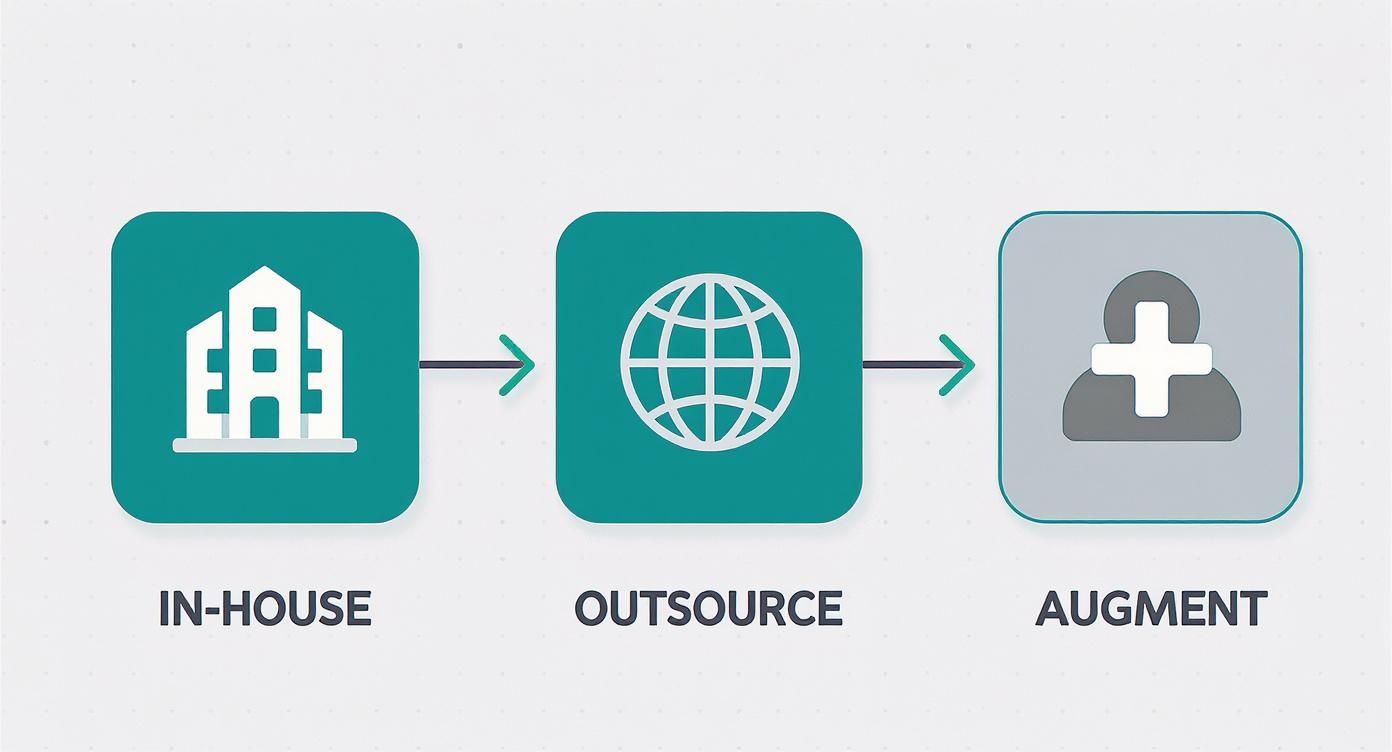
Choosing between an in-house team, an outsourced agency, or staff augmentation is one of the most critical financial decisions you’ll make. Each approach has its own obvious and hidden costs that you need to weigh carefully.
- In-House Teams: This route gives you the most control and a team that’s fully bought into your culture. But the price tag goes far beyond salaries. You have to factor in recruiting fees, benefits, payroll taxes, hardware, and office space. All in, the total cost of an employee is often 1.25 to 1.4 times their base salary.
- Outsourcing: Going offshore or nearshore can slash your labor costs, sometimes cutting hourly rates by more than half. The catch? You often pay for it with communication friction from different time zones and cultural gaps. If you don’t manage it carefully, that friction can lead to misunderstandings and expensive rework.
- Staff Augmentation: This hybrid model lets you plug specific skill gaps without the long-term commitment of a full hire. It’s flexible, but it demands strong internal management to get temporary members plugged into your workflows effectively.
The Strategic Value of Senior Talent
It might feel backward, but putting more of your budget toward experienced senior developers is a massive cost-saving move in the long run. Senior engineers don’t just write code; they bring architectural foresight and mentorship to the table.
They solve tricky problems faster, write cleaner and more maintainable code, and can guide your mid-level and junior devs. This guidance helps prevent common mistakes that turn into expensive messes later. One great senior developer can lift the performance of the entire team, making their higher salary a high-ROI investment that saves you from far bigger maintenance headaches.
Retention Is Your Best Cost-Saving Strategy
Losing a developer is shockingly expensive. Study after study shows that recruiting, hiring, and onboarding a replacement can cost anywhere from 50% to over 200% of that employee’s annual salary. And that’s before you even consider the lost productivity and institutional knowledge that just walked out the door.
Investing in developer retention isn’t an expense—it’s one of the smartest ways to control your budget. This means fostering a positive work environment, offering real opportunities for professional growth, and paying competitively. It is so much cheaper to keep your experienced engineers happy and productive than it is to constantly churn through new hires. A stable, knowledgeable team just works faster, makes fewer mistakes, and builds better software. That hits your bottom line directly.
While optimizing your team is crucial, giving them the right tools is just as important. The best way to boost productivity and slash onboarding time is with clear, automated documentation. DocuWriter.ai gives any team—in-house, outsourced, or augmented—the foundational clarity they need to work efficiently, preventing the miscommunications that lead to costly rework and delays.
Struggling to keep your development budget in check? Let DocuWriter.ai automate your documentation so your developers can get back to what they do best: coding.
Your Action Plan for Lasting Cost Reduction
Slashing your development budget isn’t about one-off fixes or finding a magic bullet. It’s about building a culture of efficiency from the ground up. This means weaving together smarter processes, strategic automation, and proactive team management into a single, cohesive strategy.
Think of it this way: Adopting Agile stops you from wasting months building the wrong features. At the same time, smart automation frees up your senior developers from mind-numbing manual tasks. Each piece reinforces the others, creating a powerful flywheel effect that drives down costs for good.
The right team structure is also a huge piece of the puzzle. There’s no single “best” model—the most cost-effective approach is the one that adapts to your project’s current needs, whether that’s in-house, outsourced, or a hybrid.